

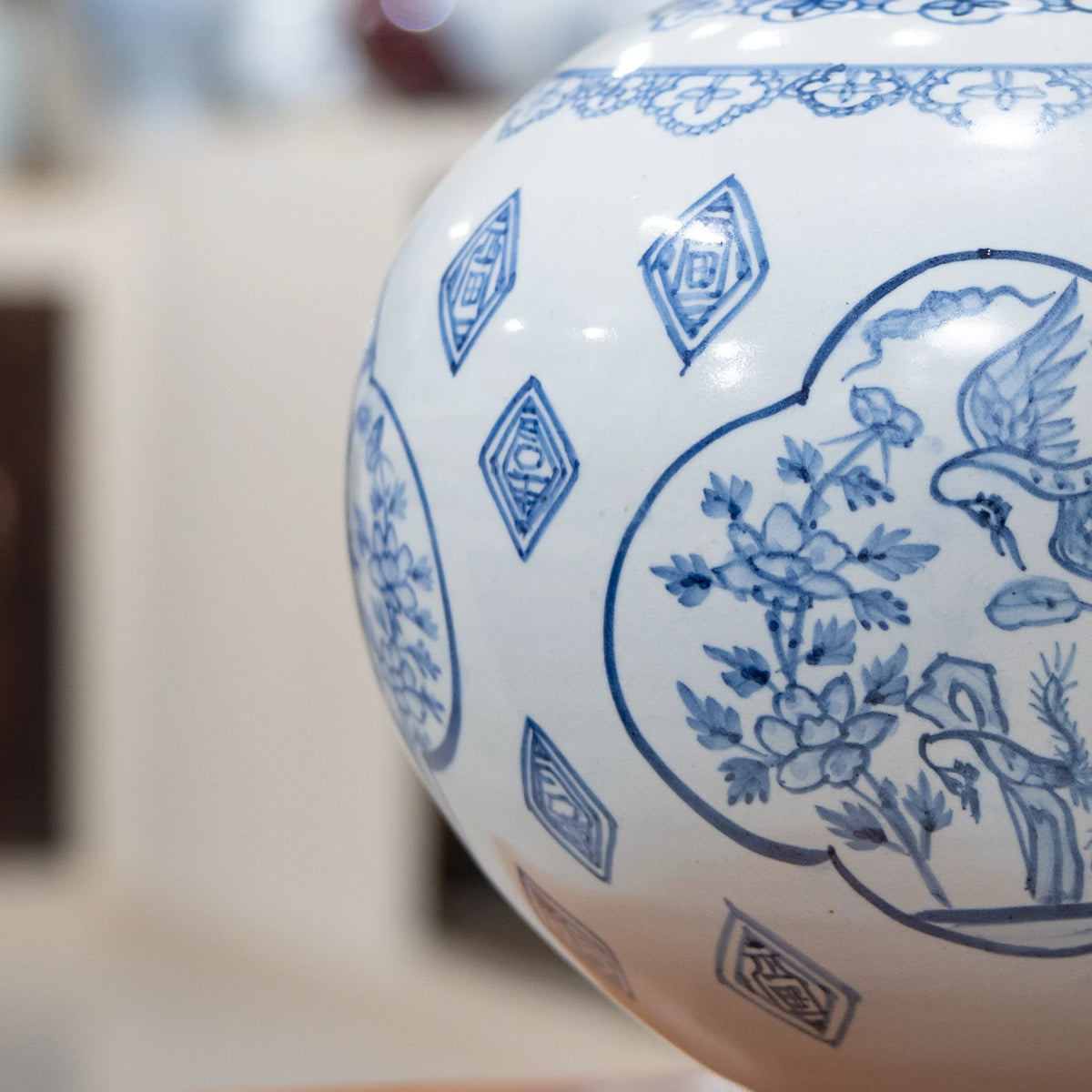
Hwachang · Window of Flowers - Grand Blue-and-White Porcelain Moon Jar
REPUBLIC OF KOREA-CERTIFIED MASTERY — Created by an officially designated Grand Master of Korea, presented with verified provenance, maker identity, and signed authenticity documentation.
Hwachang (花窓) · Window of Flowers
A Grand Blue-and-White Porcelain Moon Jar
A grand moon jar thrown on the wheel, painted by hand, and fired in a pine-burning kiln by SEO KWANG SOO, Holder of Gyeonggi-do Intangible Cultural Heritage No. 41 and Grand Master of Korea No. 367. Two windows open onto a garden where spring never leaves.
The Grand Master
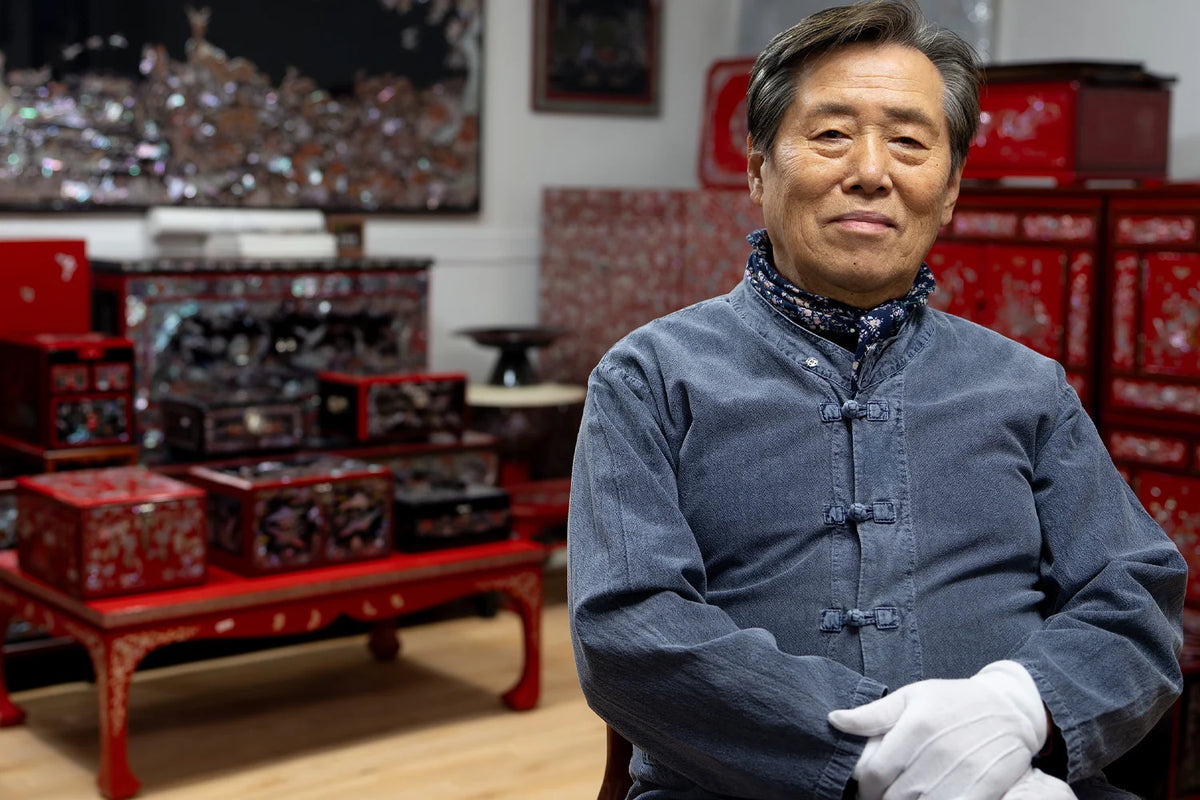
SEO KWANG SOO (徐光洙), known by his art name Hando (韓陶), was designated Grand Master of Korea No. 367 in ceramics in 2003, and in 2005 Holder of Gyeonggi-do Intangible Cultural Heritage No. 41 as Sagijang (沙器匠), master of traditional porcelain. Faithful to a tradition a thousand years old, he fires every work in a traditional wood-burning kiln.
The Work
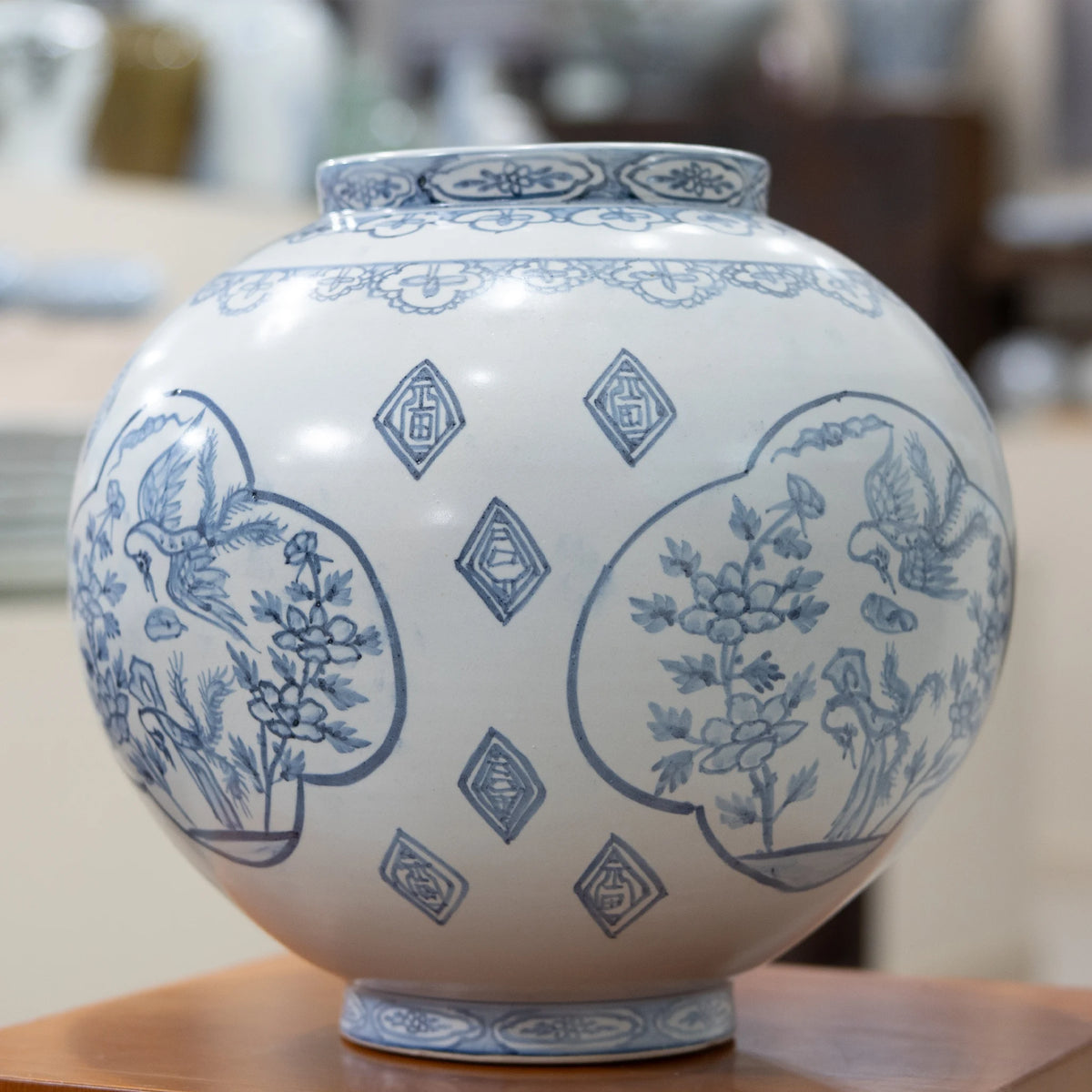
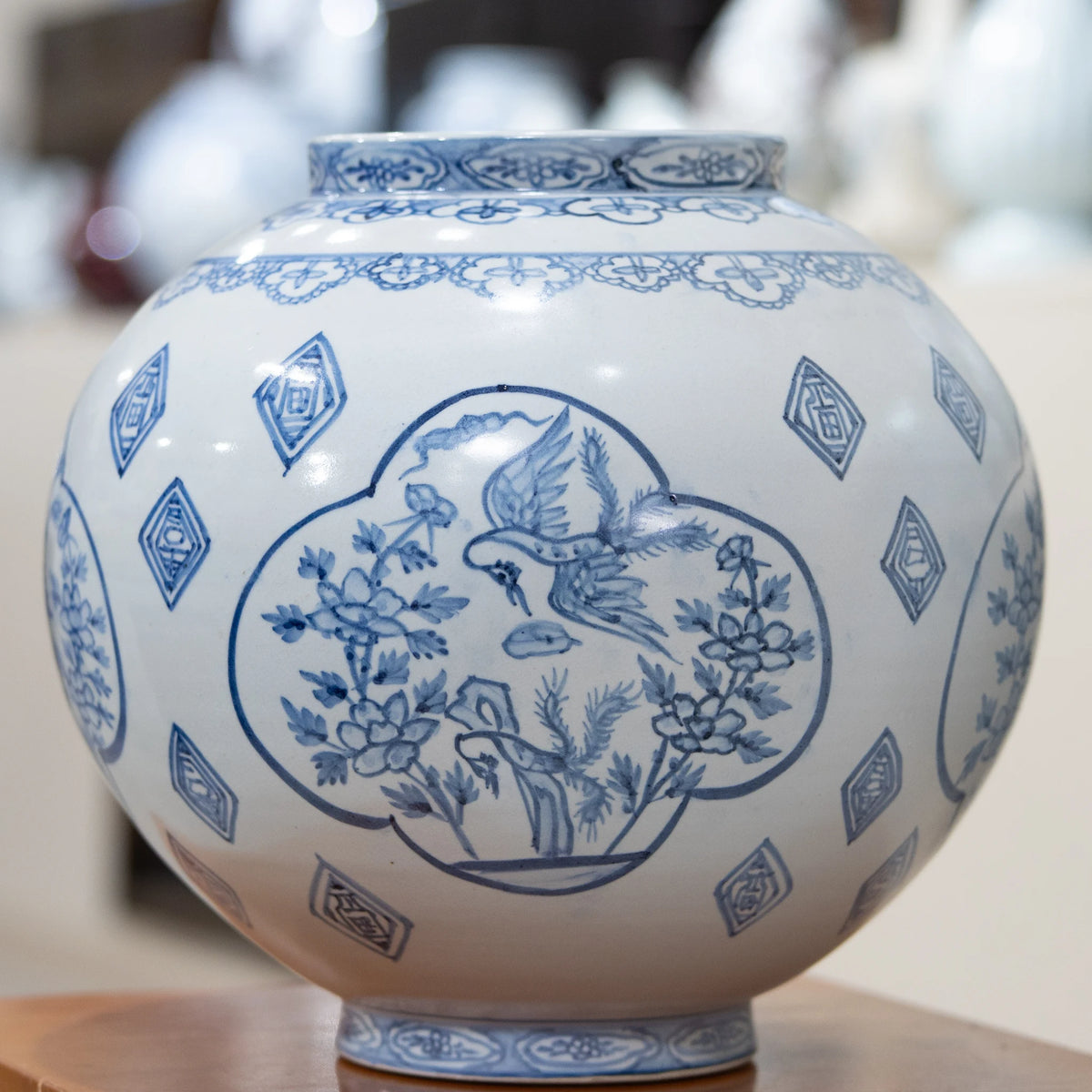
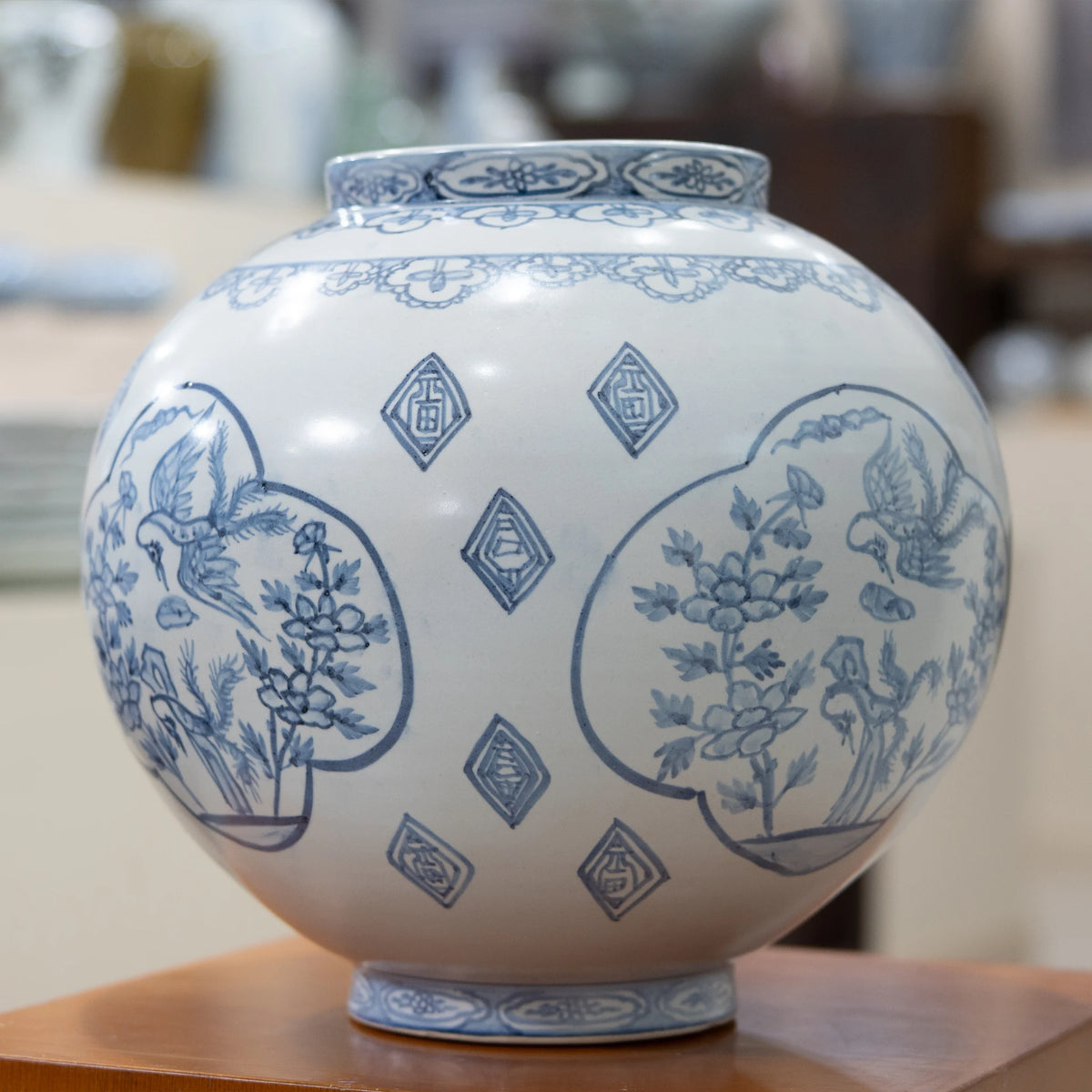
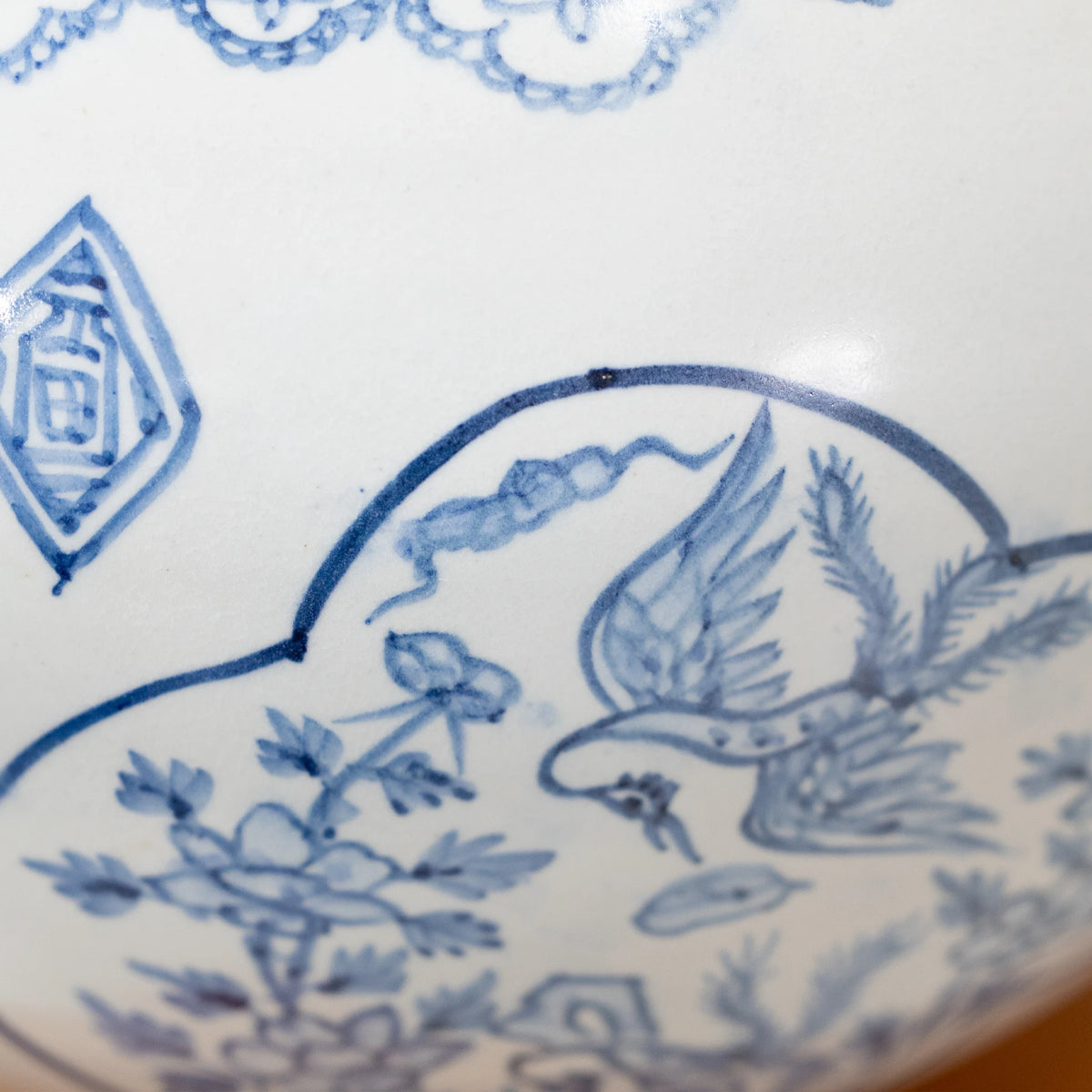
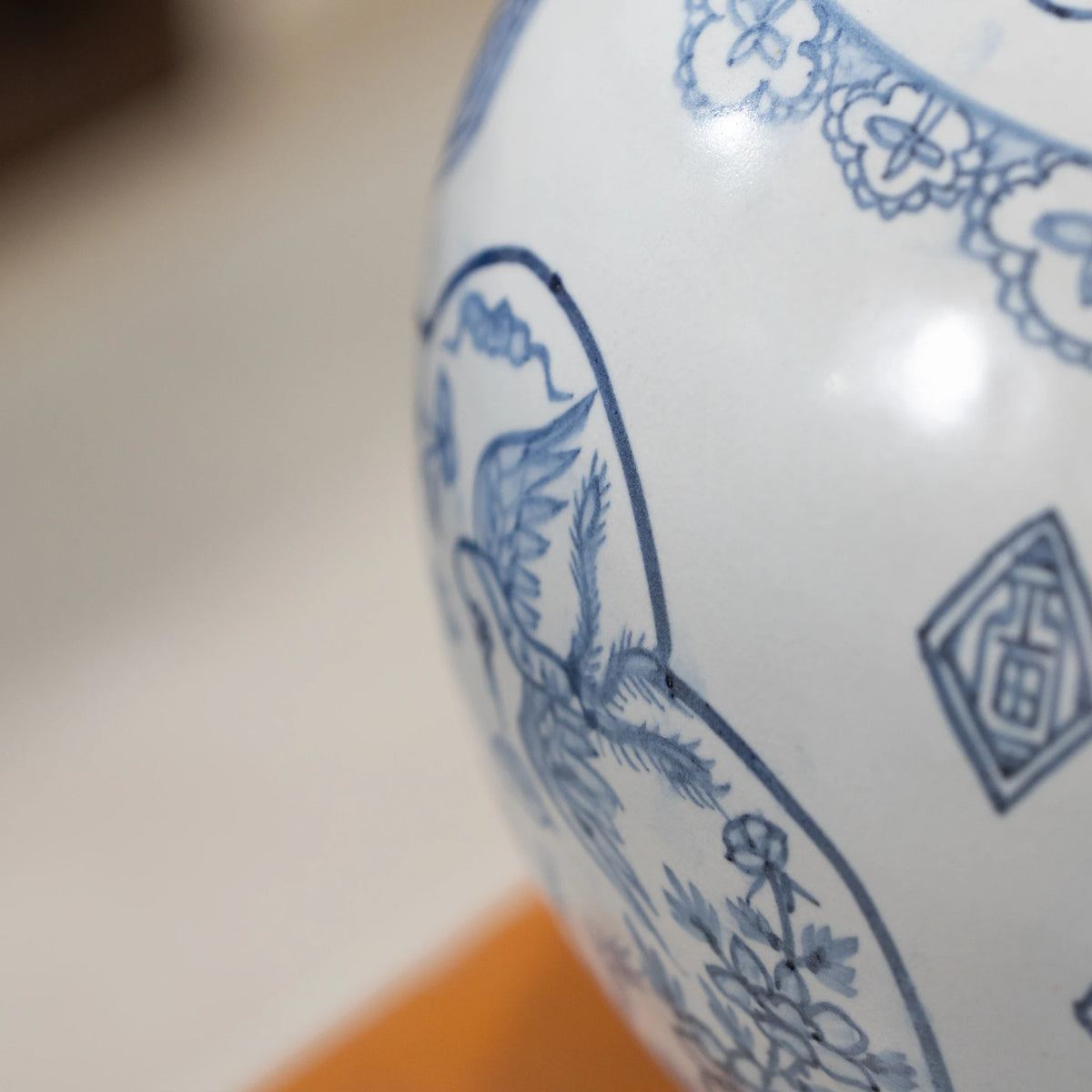
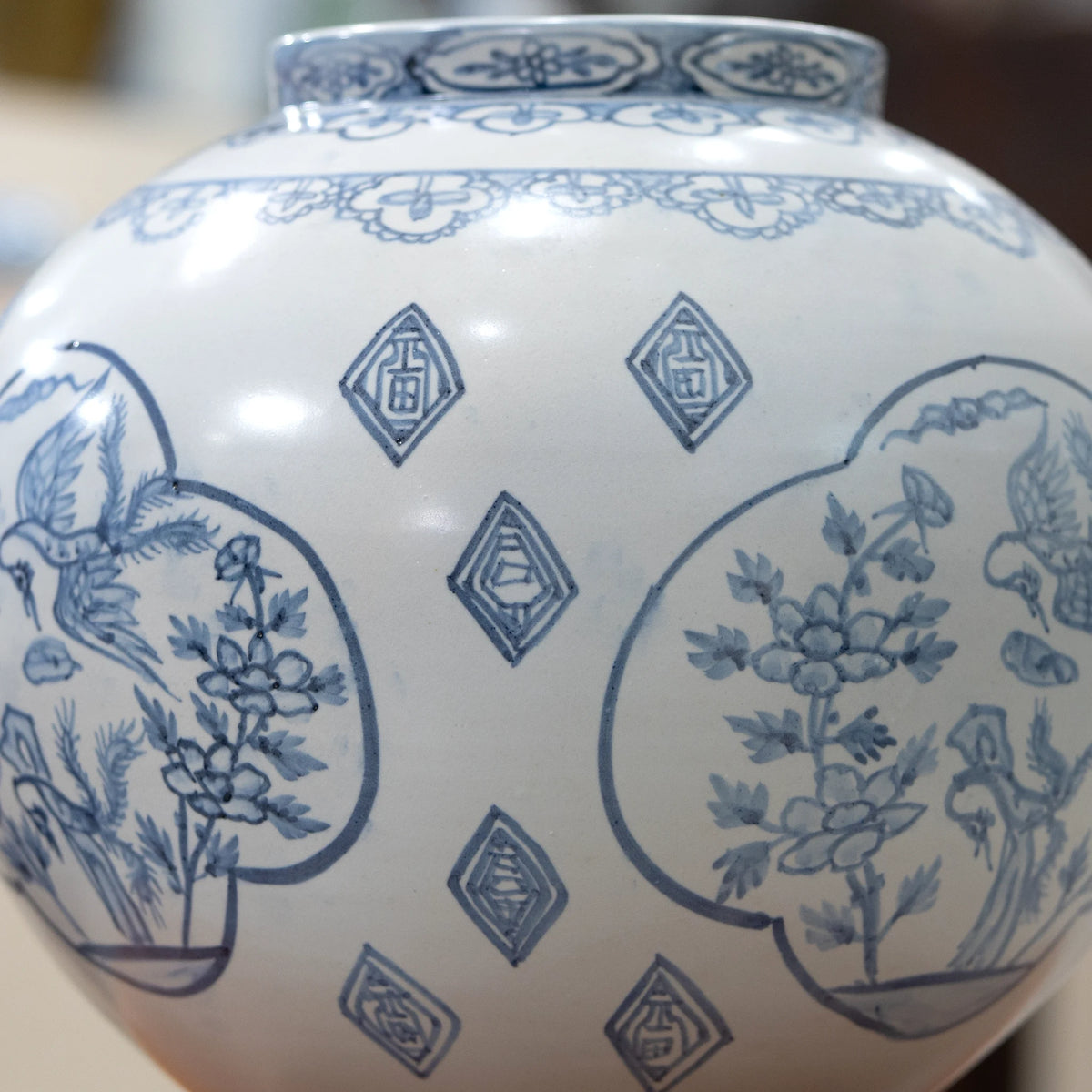
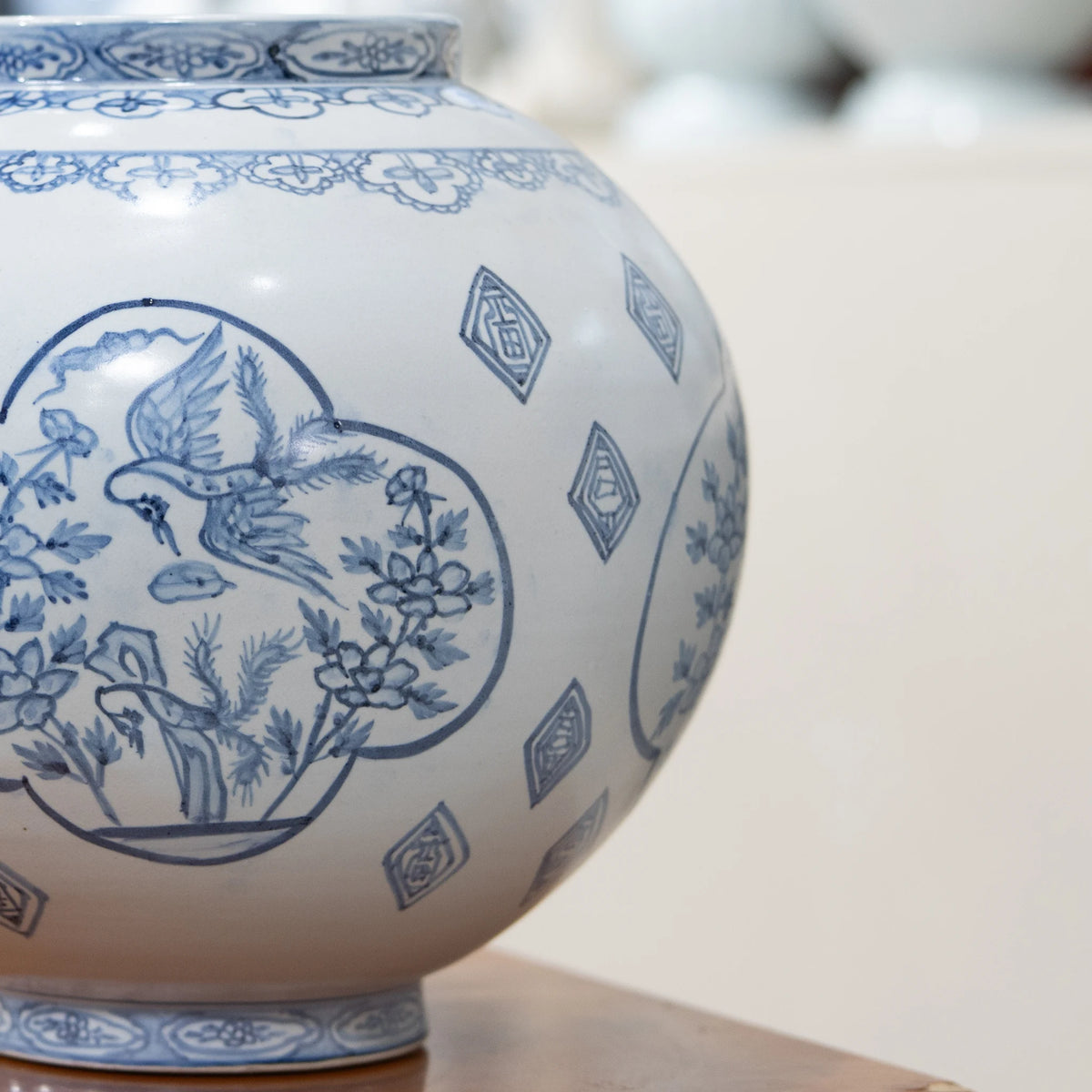
A full, gently rounded jar of white porcelain, rising more than sixty centimeters. Through each of its two quatrefoil windows, a phoenix sweeps down on outstretched wings among blossoming peonies, a garden rock, and drifting clouds. Every line is drawn freehand in cobalt blue, from deep indigo to the palest wash.
One of One
No two works in the world are alike. The brushwork and the touch of the flame differ with every piece, making Hwachang a singular work.
Natural Clay, Natural Glaze
This jar is thrown from natural clay and clothed in natural glaze, then given to the fire of a traditional kiln fed with Gangwon-do pine. Earth, glaze, wood, and flame made it.
To Endure a Thousand Years
The color of clay and glaze that have passed through fire does not fade. Goryeo celadon of the twelfth century, today a National Treasure of Korea, has kept its color for more than eight hundred years, and the white porcelain of Joseon has crossed the centuries beside it. These works came through the Korean War and stand in museums today. This jar was fired as they were, in a traditional wood-burning kiln.
At a Glance
- Dimensions: Diameter 60 × H 63 cm (approx. 23.6 × 24.8 in)
- Materials: white porcelain clay (baekto), cobalt-blue pigment, clear glaze
- Firing: a traditional wood-burning kiln, with Gangwon-do pine
- Completed: 2026. 10. 13
- Signature Record: a Certificate of Authenticity signed by the Grand Master and a Provenance Record, with a unique Record ID
- Delivery and care: insured and fully tracked international delivery in a custom wooden crate, and a Care & Conservation Guide
Reference
Style SL-S6063108
Gaegwang: Opening the Light
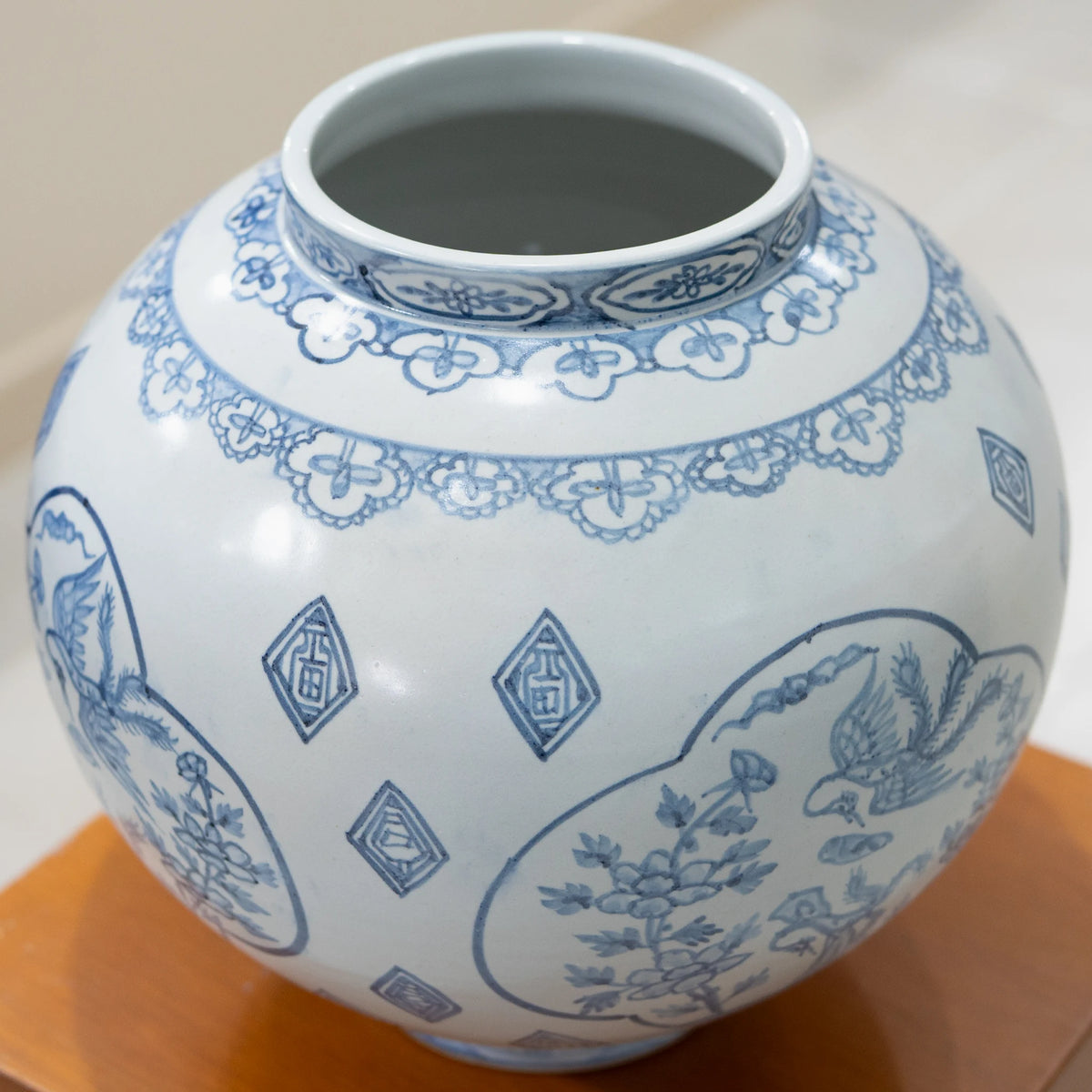
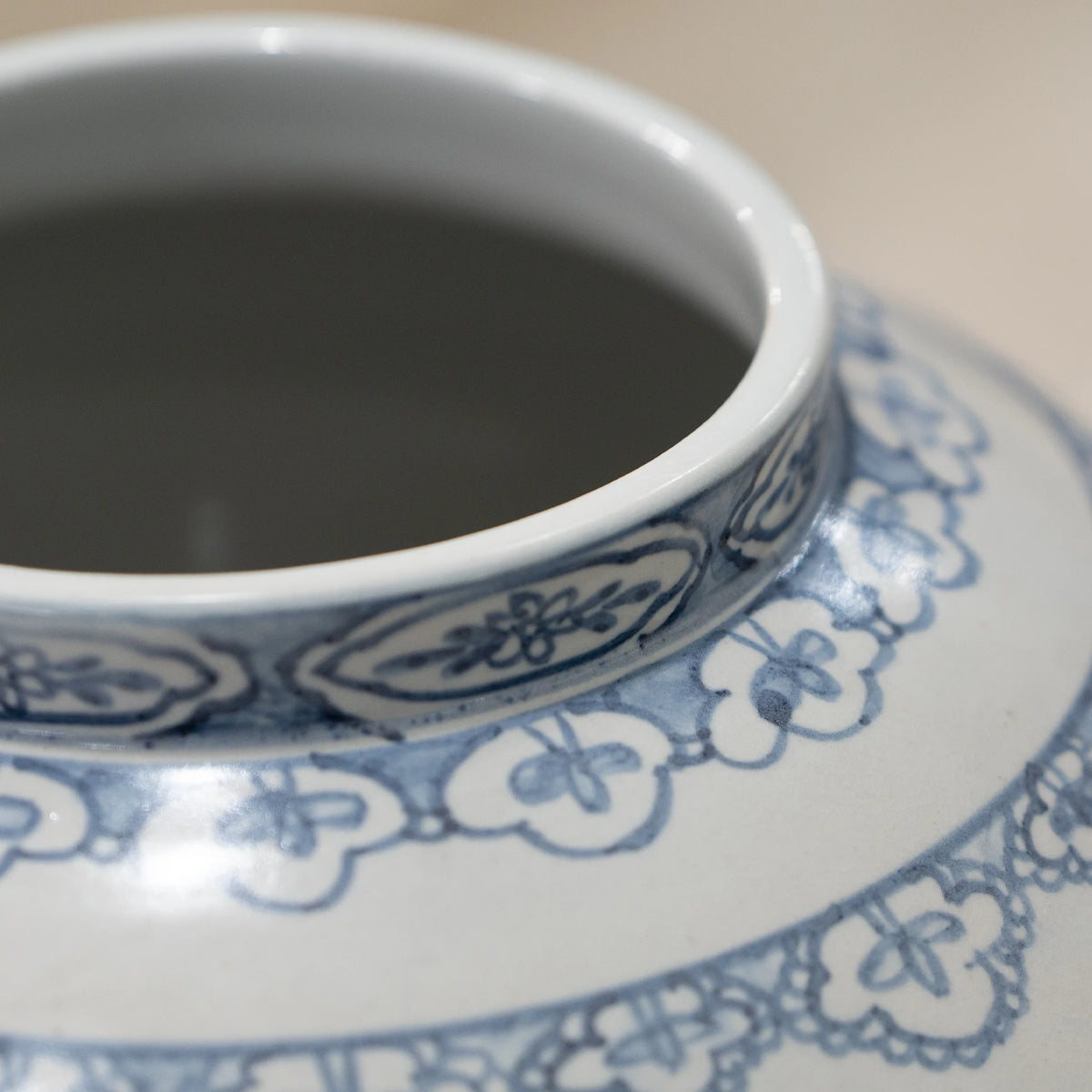
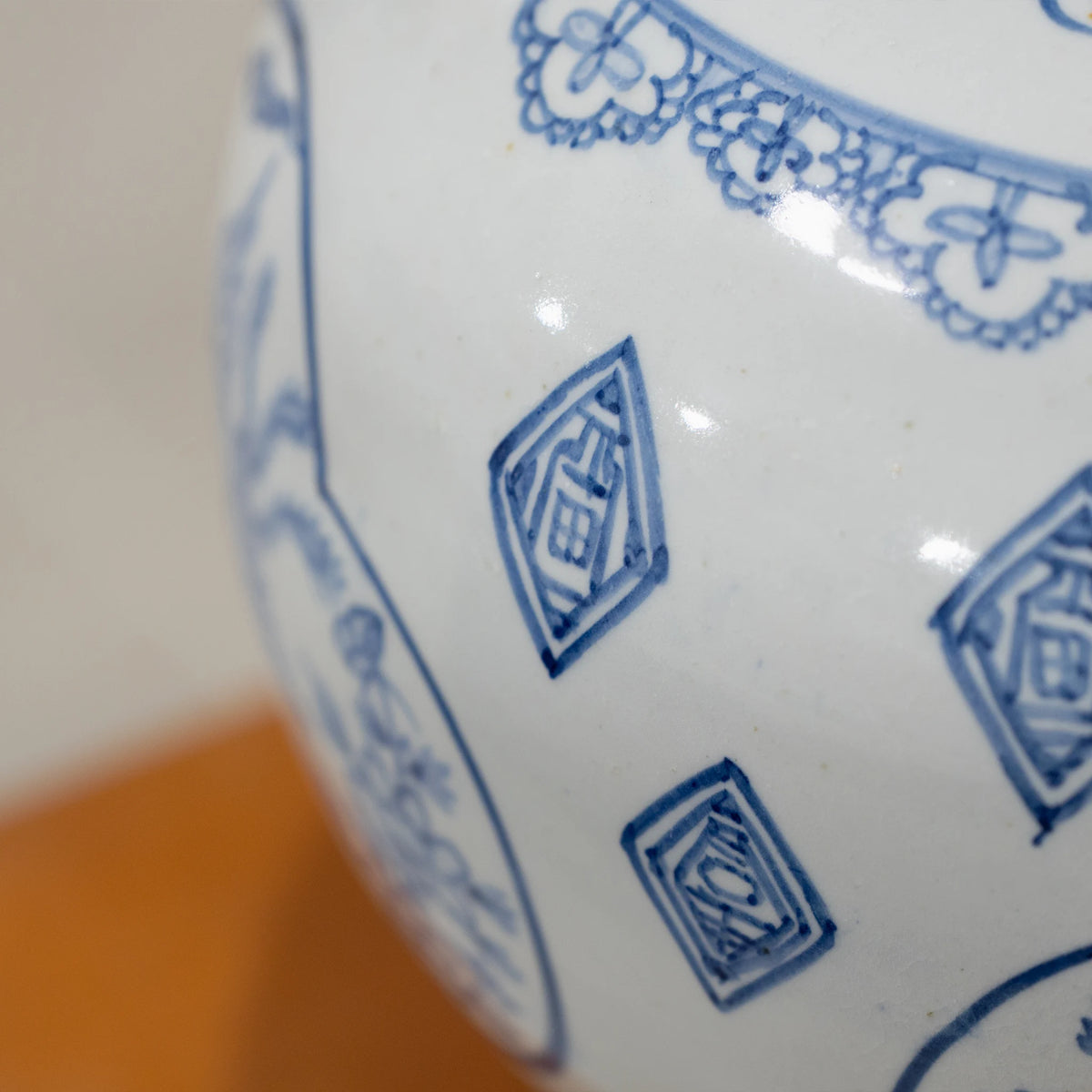
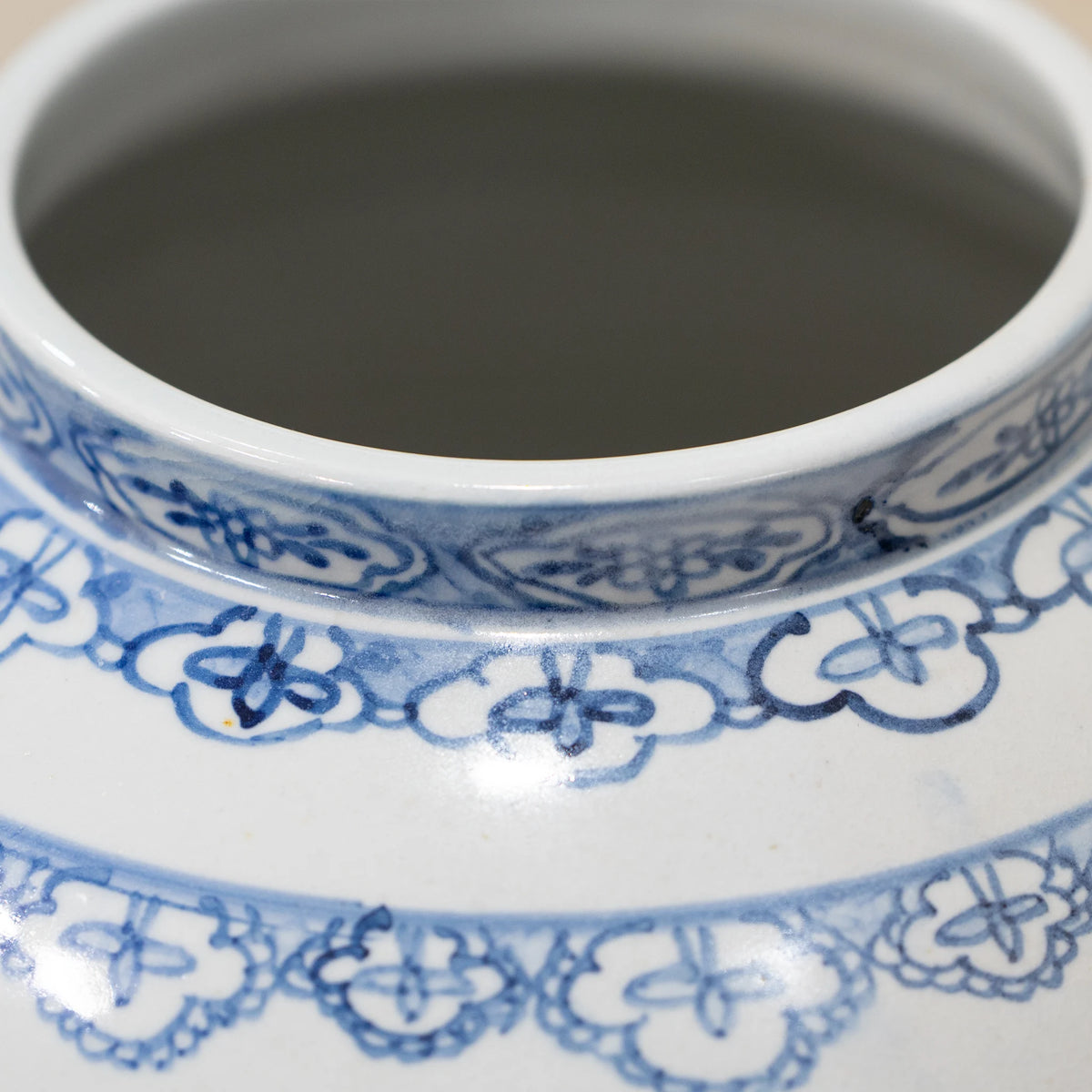
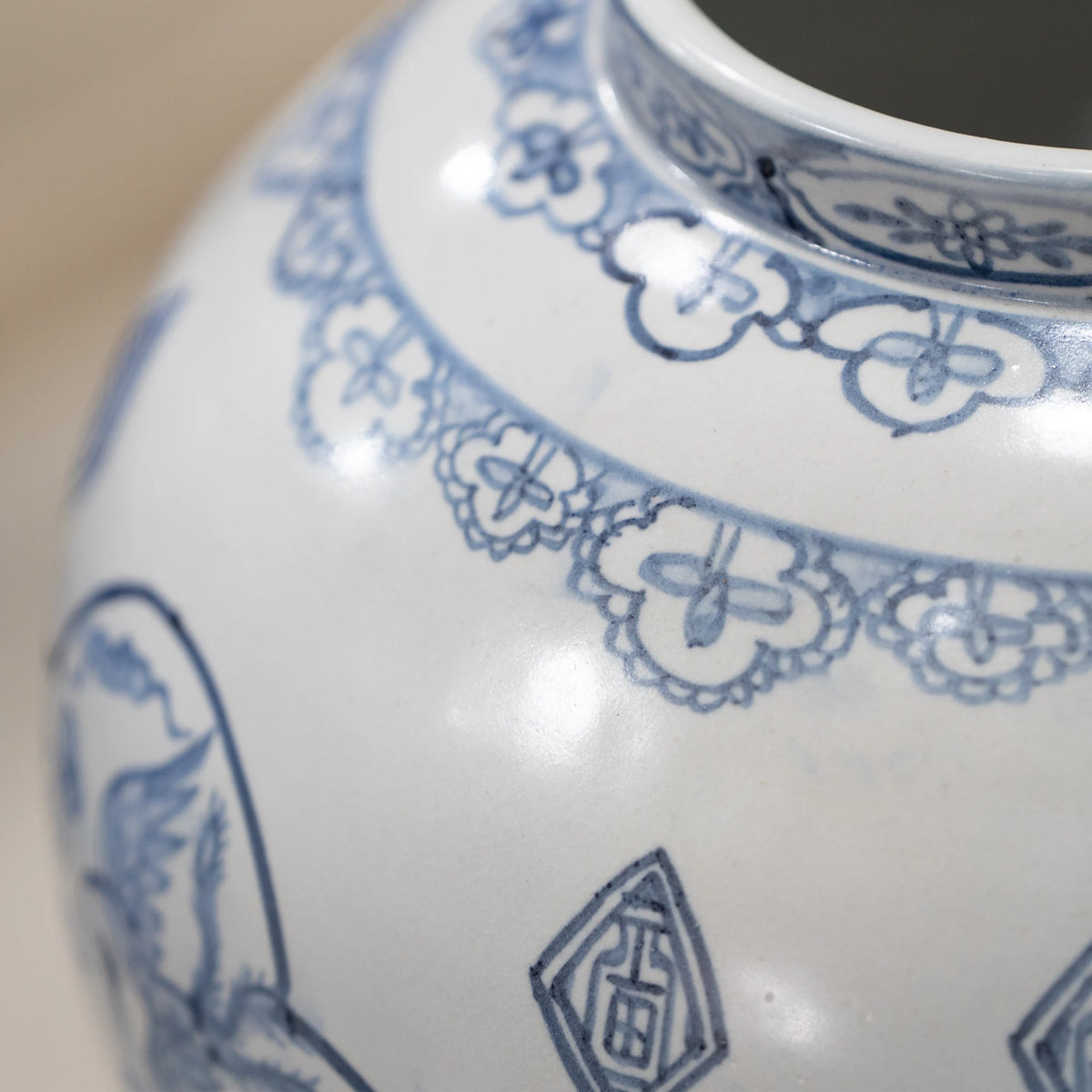
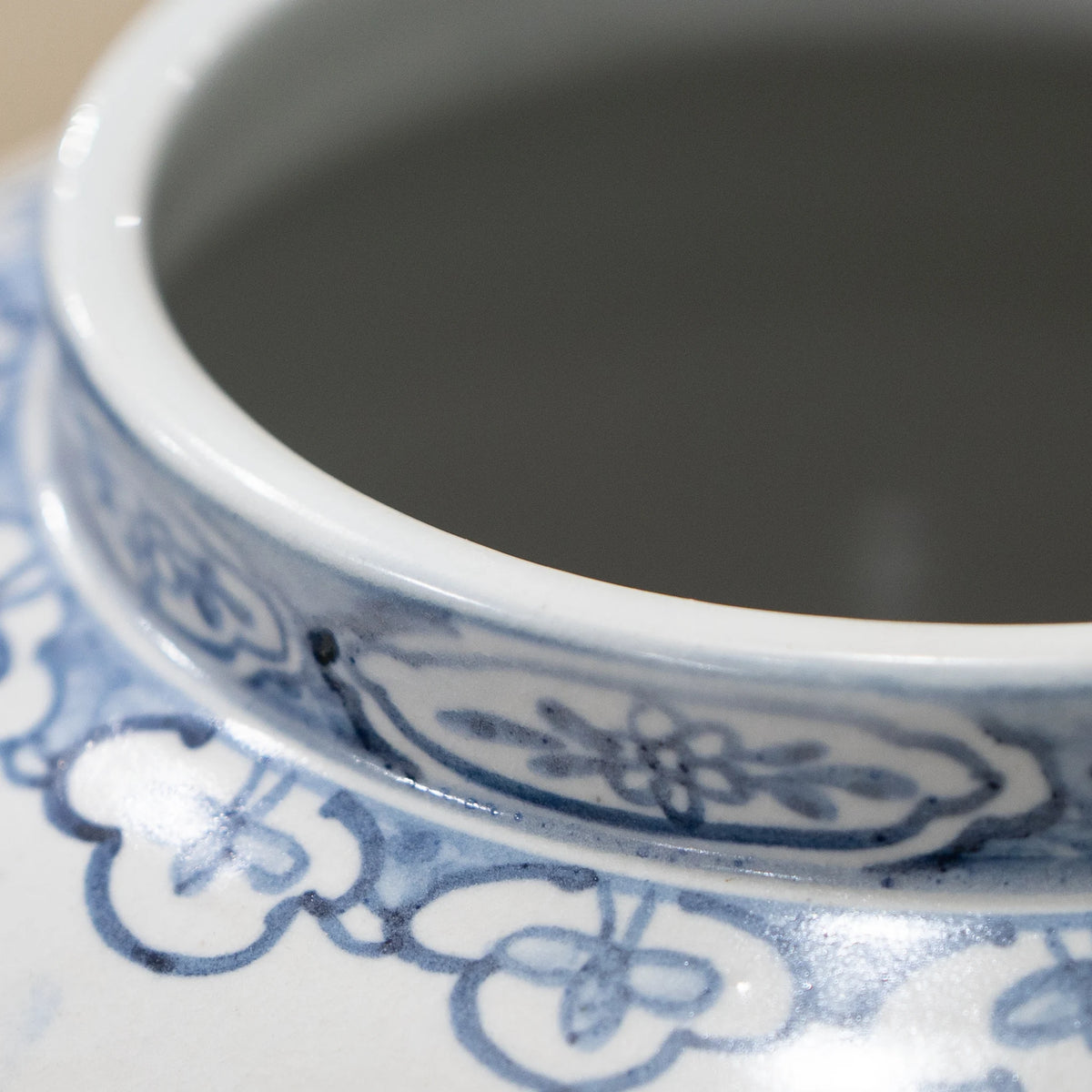
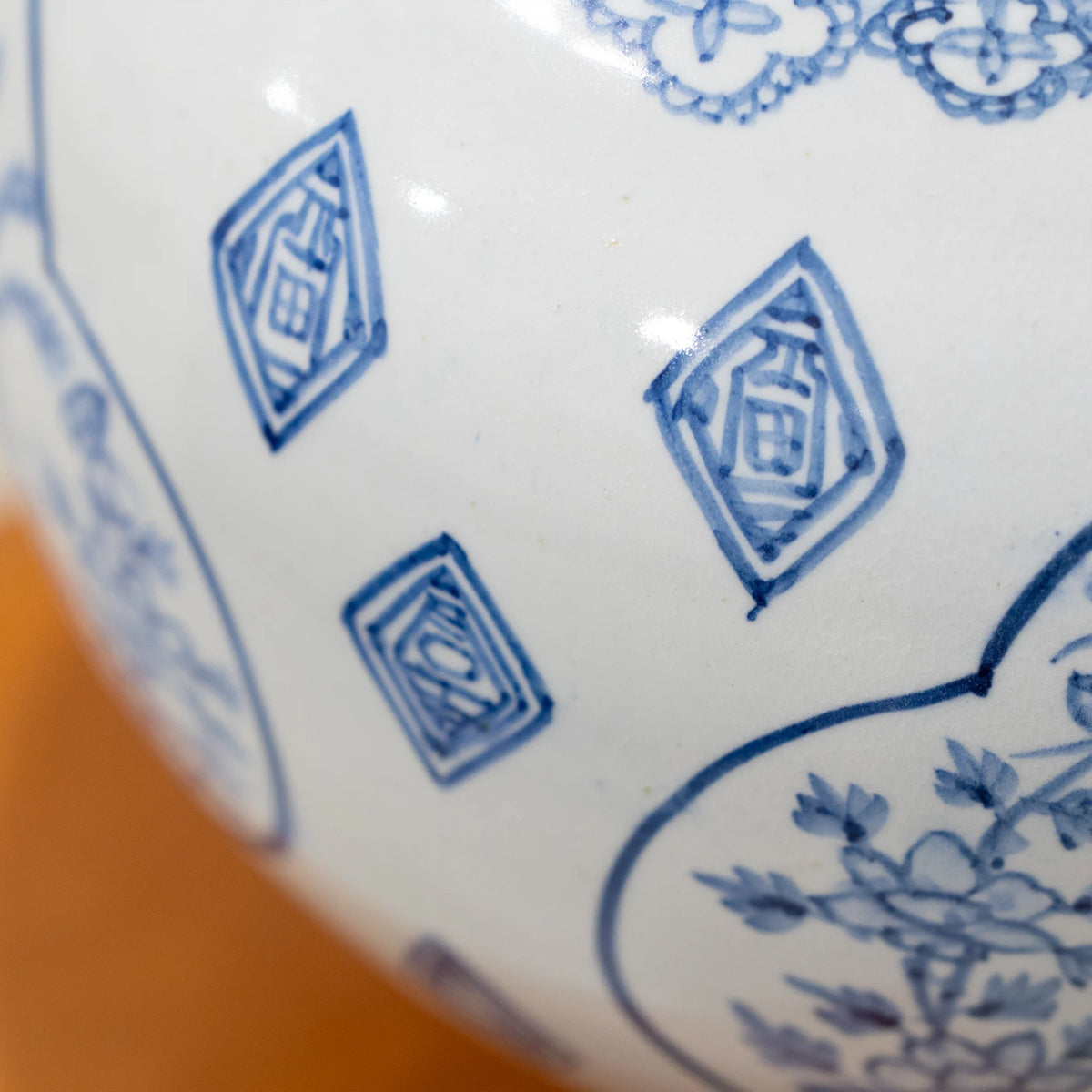
Hwachang, “a window of flowers,” opens two quatrefoil windows like latticed windows in the wall of a traditional Korean house. Between them, lozenge medallions bearing the character 福 (bok, “fortune”) are set like small jewels across the white ground, alternating with lozenges of fine lattice. Around the shoulder, a band of cloud-head motifs falls like a lace collar; the mouth is ringed with small floral panels, and a slender band encircles the foot. The whole surface breathes like ink on paper.
In Joseon porcelain, this way of framing a painting within a panel is called gaegwang (開光), literally “opening the light,” one of the most refined compositions in Korean blue-and-white ware. To look through a window of flowers into a garden is to hold a quiet wish: that spring may always dwell within the home.
The Moon Jar: Korea’s Vessel of the Full Moon
In the late Joseon Dynasty, Korean potters created round white jars of such quiet, generous beauty that later generations named them dalhangari, “moon jars,” for their likeness to the full moon rising over the hills. Never perfectly symmetrical, softly luminous, and calm as moonlight itself, the moon jar has become the most beloved emblem of Korean beauty. Today the finest historic examples are designated National Treasures of Korea.
Blue-and-white porcelain held a place of special honor in Joseon. Cobalt blue was an extraordinarily costly pigment, and for centuries its use was largely reserved for the royal kilns. A jar painted in blue was, from the beginning, a vessel of celebration and good wishes.
Jars of this scale are among the most demanding forms in all of Korean porcelain: the larger the vessel, the greater the risk that it will slump, crack, or warp in the fire. A grand jar that emerges whole from the wood-fired kiln is a rare achievement, and a centerpiece for a residence, an embassy, or a collection.
As a gift for a new home, a wedding, a family milestone, or a gesture of respect across nations, Hwachang carries a message every household understands: may this home be filled with lasting peace, honor, and fortune.
A Garden Seen Through Windows
- The windows (gaegwang) — two quatrefoil panels that frame the garden like a painting, inviting the eye to look in and linger
- The phoenix (bonghwang) — the most auspicious of birds in Korean tradition, said to appear only in an age of peace and virtue; a herald of harmony and good tidings for the home
- The peony — long revered in Korea as the flower of wealth and honor; together with the phoenix, a wish for a life of peace, prosperity, and dignity
- The garden rock — a timeless emblem of longevity and steadfastness
- The 福 medallions — the character for fortune and blessing, scattered across the jar like charms
- The cloud-head band — encircling the shoulder, a traditional motif of wishes fulfilled
The Craft: Shaped by Hand, Fired by Pine and Flame
- White porcelain clay (baekto) — refined white clay, prepared for a pure, luminous body
- Thrown on the wheel by hand — the full, rounded form is shaped by the Grand Master’s own hands, never cast in a mold
- Painted freehand in cobalt — every phoenix, petal, and border is drawn directly by brush, with no stencils or transfers, so that no two works carry the same line
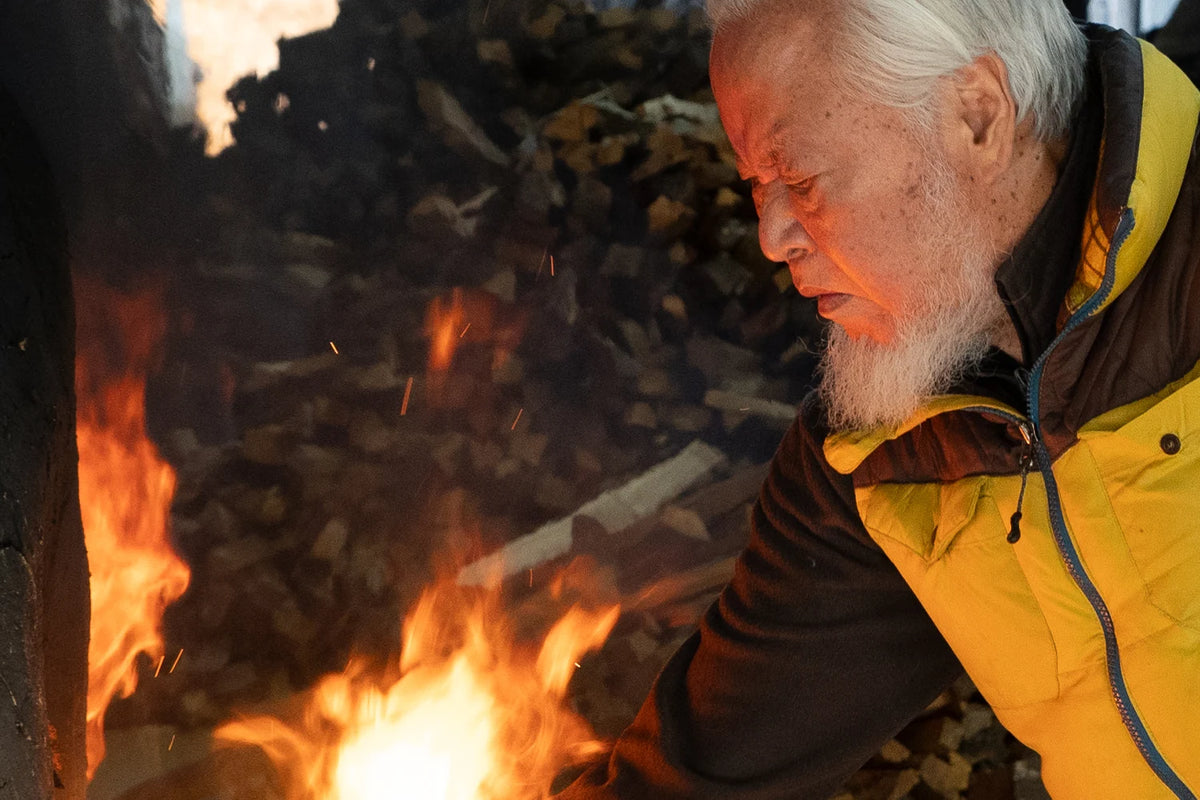
- Fired with Gangwon-do pine — The work is fired in a traditional wood-burning kiln fed with pinewood from Gangwon-do. The Grand Master regards this firing as the most important stage of all, one that can be mastered only through decades of instinct. The living flame leaves each surface its own soft variation of tone that no modern kiln can reproduce.
- Wholly by hand, from beginning to end — from the clay, to the brush, to the fire
Fired at high temperature, porcelain becomes dense, durable, and resistant to time. Cared for simply, Hwachang will remain as clear and bright for generations to come as on the day it left the kiln.
The Grand Master’s Porcelain
His works are exhibited in Korea’s national museums as porcelain representative of the nation, and they have represented Korea in national museums of the United Kingdom, Japan, Germany, and Russia. His porcelain is cherished for its freedom of form and brush, and for a clear, almost childlike purity.
Specifications
- Work — Hwachang (花窓) · Window of Flowers
- Formal Title — White Porcelain Jar with Underglaze Cobalt-Blue Phoenix-and-Peony Design in Reserved Panels (白磁青華開光鳳凰牡丹文壺)
- Master — SEO KWANG SOO (徐光洙), art name Hando (韓陶)
- Honors — Holder of Gyeonggi-do Intangible Cultural Heritage No. 41 — Sagijang (designated 2005); Grand Master of Korea No. 367 — Ceramics (designated 2003)
- Dimensions — Diameter 60 × H 63 cm (approx. 23.6 × 24.8 in)
- Materials — White porcelain clay (baekto), cobalt-blue pigment, clear glaze
- Techniques — Wheel-throwing, freehand underglaze cobalt painting, gaegwang (reserved-panel) composition, wood-firing in a traditional kiln with Gangwon-do pine
- Completed — 2026. 10. 13
- Edition — One of a kind
Accompanying Every Masterpiece
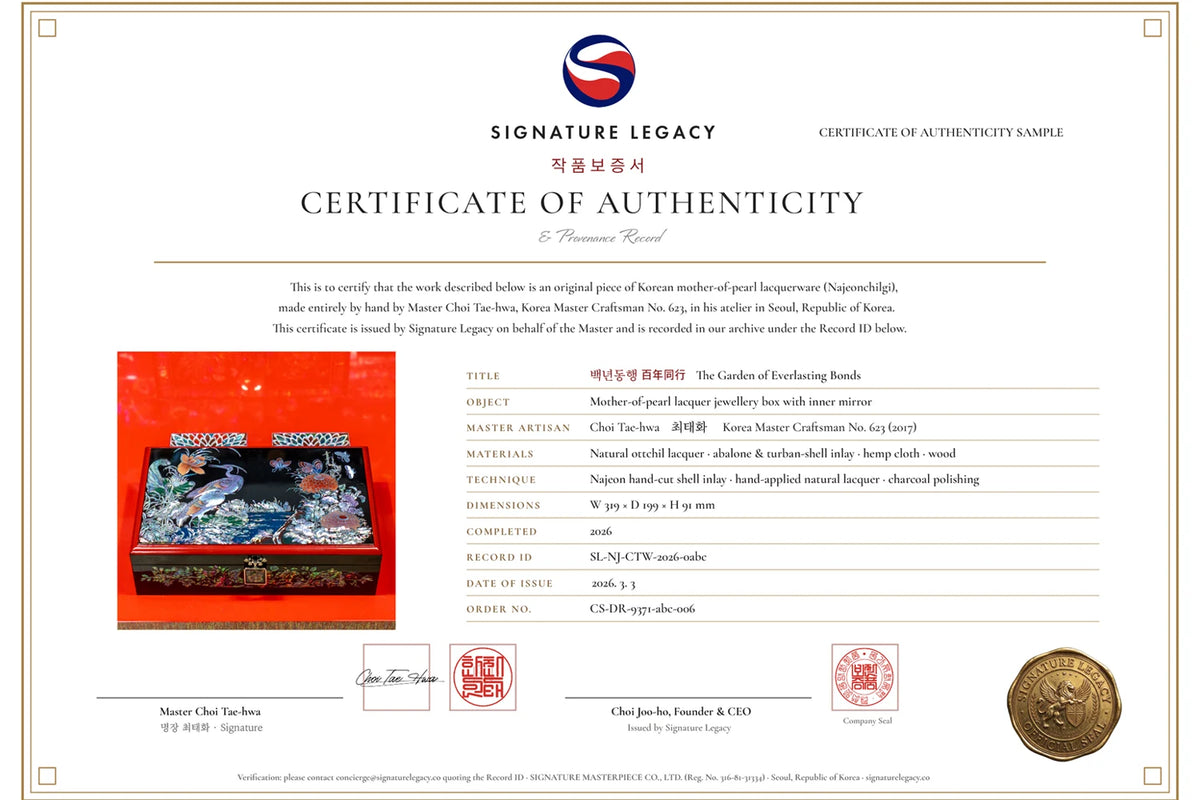
- Certificate of Authenticity — signed by the Grand Master, recording the work, materials, dimensions, year of completion, and a unique Record ID
- Provenance Record — a permanent record of the work’s origin, its confirmed author, and its identifying features
- Secure Delivery Documentation — insured, fully tracked international delivery in a custom wooden crate with triple-layered protective packaging made for grand porcelain
- Care & Conservation Guide — guidance on displaying and caring for wood-fired porcelain, so that the work may be handed down for generations
Signature Legacy presents only the works of masters officially recognized by the Republic of Korea, each verified at the master’s own atelier from the very first stage of its making.
OWN WHAT CANNOT BE RECREATED
No masterpiece by an officially designated Grand Master of Korea can be made twice. Each is shaped entirely by hand, with exacting precision, using techniques that few living artisans can still command. Its final color, though, is decided by nature. No one can foretell how the flame will travel through a traditional kiln fired with Korean pine, or what tone the glaze will take. The Master gives the work everything; the final result is decided by nature, as the fire, the wind, and the weather lead it.
So whichever work you choose, it is the only one of its kind in the world. If a completed work is available, it is dispatched immediately upon your order, fully insured. Should you wish to commission a work in the likeness of one you admire, its creation begins the day your order is confirmed. The Master will bring it as close as a hand can, and it will still be a work of its own, made once, for you. It will typically arrive within 30 days to 6 months, the exact timeline shaped by its scale, intricacy, and the Master’s own hand.
The time you spend waiting becomes part of the artistic value of a work that exists only once in the world.
The number of masters recognized by the Republic of Korea is limited, and the works each can complete in a lifetime are fewer still. As these traditions grow rarer with each passing year, every authenticated work carries a deeper cultural significance, a quieter scarcity, and a value that only grows with time.
For the collector who seeks the truly irreplaceable, this is more than an acquisition. It is the privilege of owning a one-of-a-kind Korean masterpiece, and of becoming part of its story.
AN ORIGINAL, EVERY TIME — CONFIRMED BEFORE IT IS BORN
Each Signature Legacy masterpiece is shaped entirely by hand by an officially designated Grand Master of Korea — an artist guided by decades of instinct, never by a fixed template. The spirit of the Master's hand lives in every work; yet no two compositions, and no two masterpieces, are ever exactly alike.
Before your commission begins, our Collector Concierge presents the Master's proposed design and motifs for your piece. Only after you have reviewed and approved them does the Master's hand begin its work — so that the masterpiece created for you exists, in form and in spirit, for you alone.
Masterpiece DESCRIPTION
Dimensions & Weight
Materials & Care
Our Commitment
Choose options
The Atelier · A film from the master’s workshop
Where Eternity Is Born

The Master · An Interview in His Own Words
What a Lifetime Teaches

The Proof · Opened by the Master’s Own Hand
The Moment the Kiln Opens
- Firing
- 72 hours · Gangwon pine
- Drawn from the kiln by
- Seo Kwang Soo, Grand Master of Korea No. 367
- Kept in
- The provenance dossier of this work